For decades, the science of feeding a critically ill or injured person came down to an equation. Predictive formulas, some more than a century old, used a person’s age, weight, and height to estimate how many calories they burned each day. It was the best tool available. It just wasn’t very accurate.
“[A Registered Dietitian’s] math is maybe less than 50% accurate for the general population,” says Jasmine LeBlanc, a registered dietitian at the Stan Cassidy Centre for Rehabilitation in Fredericton. “And we know that the people we see here at SCCR are far from being general population. They have very unique needs.”
That gap between estimate and reality has real consequences. Underfeeding puts people at higher risk of infection, pressure ulcers, and muscle loss, which can extend a hospital stay. Overfeeding brings its own risks, including weight gain that can make mobility, and even fitting into a wheelchair, more difficult. For people already working hard to recover, getting nutrition wrong can set them back.
Thanks to donor support, that guesswork is no longer the only option.
A Direct Measurement, Not an Estimate
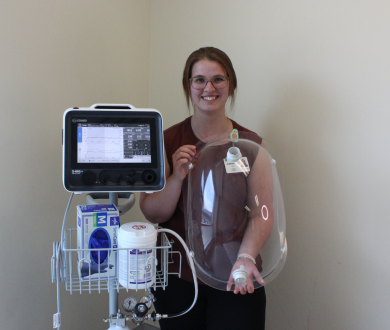
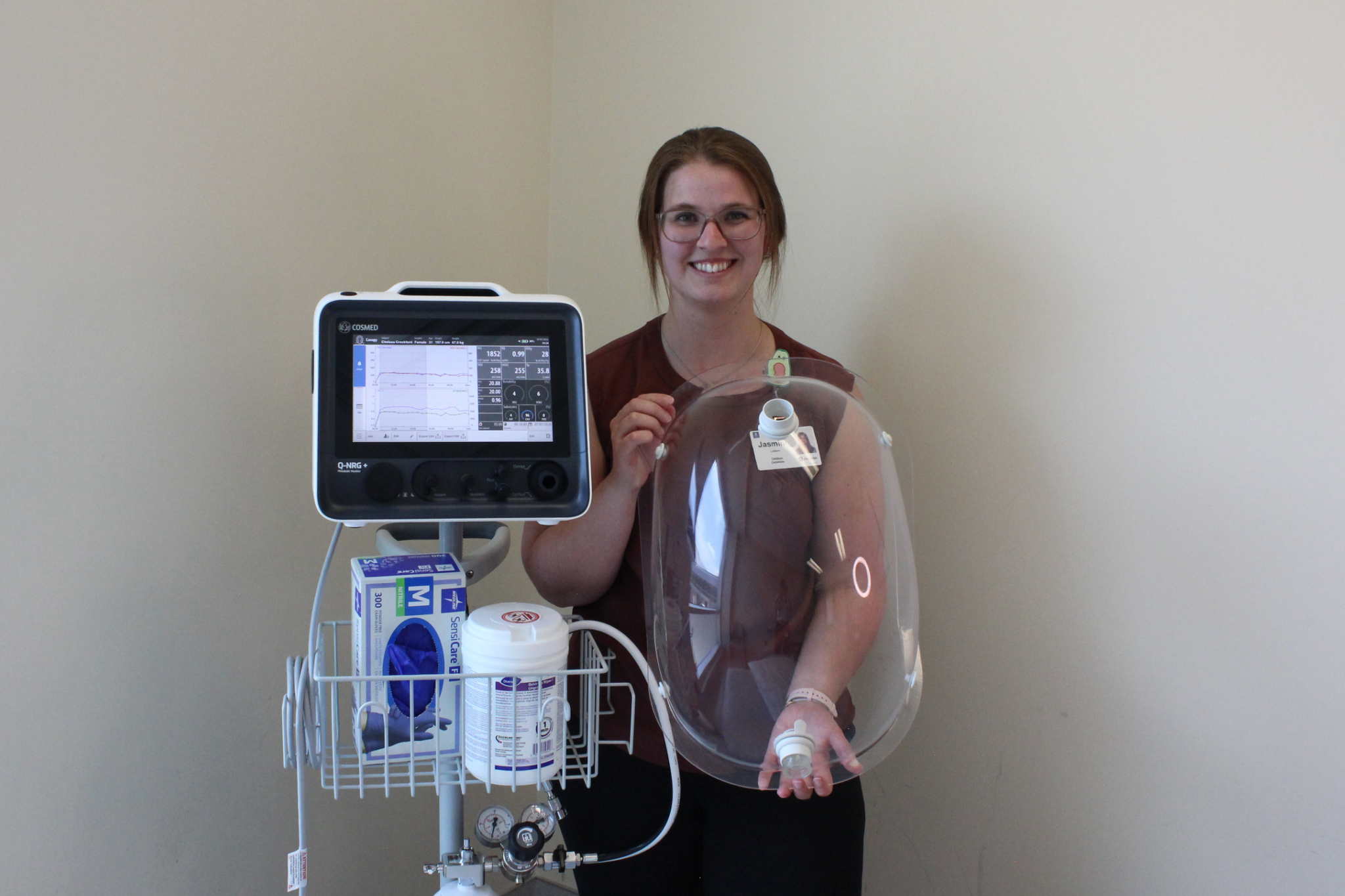
The Q-NRG+, a metabolic cart funded through Chalmers Foundation donors, gives the Stan Cassidy Centre for Rehabilitation and the Dr. Everettt Chalmers Regional Hospital’s nutrition teams something the old equations never could: a precise, individual reading of exactly how much energy a person’s body is using.
The concept is called indirect calorimetry, and it’s been considered the gold standard in nutrition care for years. What’s new is that it’s finally practical to use every day.
“We always knew that indirect calorimetry was the gold standard for care,” LeBlanc explains. “We simply did not have the technology to use it with patients day to day. It used to be big, bulky machines that we couldn’t transport. [The Q-NRG+] is very light, very portable, very convenient.”
Here’s how it works in practice. For most people, the test uses a canopy, a clear hood placed gently over the head and sealed at the shoulders while the person simply rests and breathes normally. For people in the ICU who can’t breathe on their own, the machine can take the same measurement through a ventilator. Either way, by measuring the oxygen a person breathes in and the carbon dioxide they breathe out, the Q-NRG+ calculates precisely how many calories they’re burning at rest, along with what fuel source their body is using in that moment, whether that’s carbohydrates, fat, or protein.
The whole test takes about ten minutes. The old approach of tracking food intake and weight trends could take weeks to arrive at a rough answer, and for someone using a wheelchair, even getting an accurate weight can be a challenge on its own.
What Changes for the People in Our Care
The accuracy of the machine is the headline, but LeBlanc says the real shift is in what that accuracy makes possible for the people she works with.
“When it comes to nutrition, a lot of it is grey,” she says. “[The Q-NRG+] gives you a concrete number to reach, and that makes it easier for people to see it in black and white and know what they need to do.”
That clarity changes how people engage with their own care. LeBlanc has noticed people get invested in their nutrition plans o nce they’ve seen their own results and are more willing to follow her recommendations because there’s data behind them. She compares it to another area of medicine entirely: “You wouldn’t guess somebody’s blood pressure and medicate based on that. Similarly, we need to have measured information when it comes to providing our nutrition interventions.”
The device has already changed outcomes for real people at Stan Cassidy Centre for Rehabilitation. In one case, a routine test showed a person burning mostly fat shortly after a meal, a result that didn’t add up. It prompted further investigation and led to a diagnosis of pancreatic insufficiency that might otherwise have gone unnoticed. In another case, a person with a wound that wasn’t healing turned out to need significantly more calories than their care plan provided. Once the team adjusted his nutrition based on the Q-NRG+ reading, the wound began to heal.
“Without this device, it would just take time,” LeBlanc says of what those situations would have looked like before. “We would have to do a lot more investigation… it would have taken a lot more time to get the right balance of nutrition to get those people to thrive.”
What This Means for Our Donors
Chalmers Foundation exists because our community steps up for the New Brunswickers who need care at Stan Cassidy Centre for Rehabilitation, and this is exactly the kind of impact that support makes possible.
“I would like donors to know that [the Q-NRG+] allows us to provide gold standard care to our patients and clients,” LeBlanc says. “Without this device, we were relying on math … that is not always accurate.”
A ten-minute test. A precise number instead of a best guess. A wound that’s healing because someone finally had the information they needed to help it.
That’s what your generosity funds.
Help us continue to make a difference for the patients and staff at the Stan Cassidy Centre for Rehabilitation. Donate today.